Nipple Ring Sizing Chart: Choosing a Comfortable Fit
A nipple ring sizing chart can help you compare jewelry measurements before choosing a style or planning a replacement. The key is knowing what each number describes: gauge is thickness, bar length is the wearable post, and ring diameter measures across the inside of a ring. A chart is a starting point, not a substitute for matching the jewelry to the piercing and its current condition.
Contact Z-Edge about piercing jewelry
What does a nipple ring sizing chart measure?
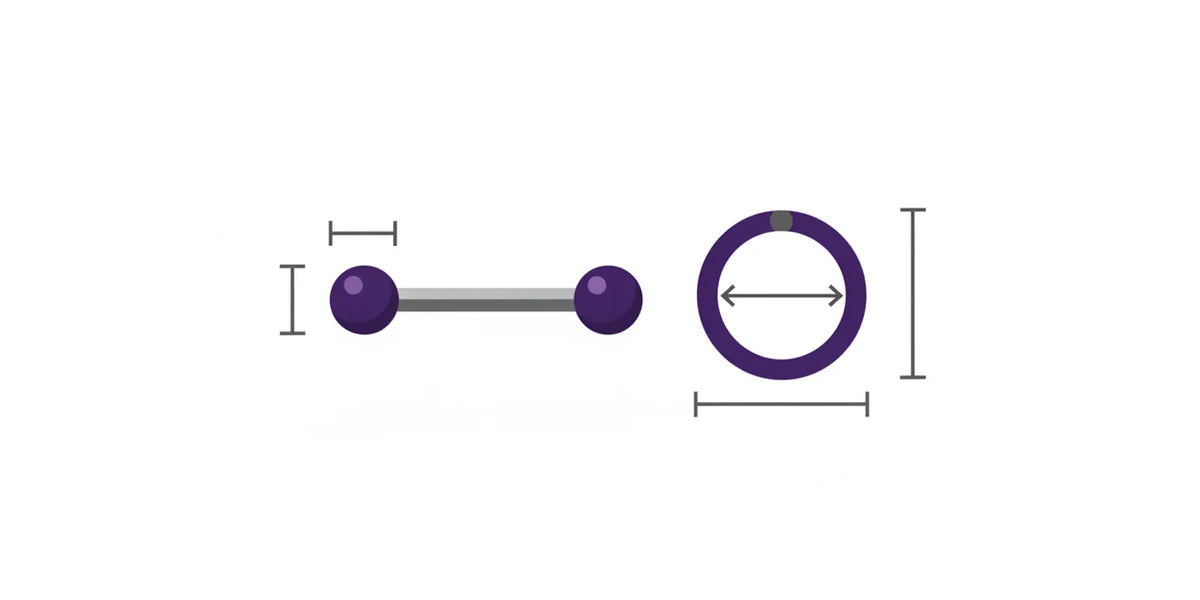
Most listings describe two important dimensions. Gauge is the thickness of the post or ring wire. The second measurement depends on the jewelry shape: a barbell listing usually gives wearable length, while a ring listing usually gives inner diameter. These dimensions answer different questions. Do not treat equal-looking numbers as interchangeable.
Gauge numbering can seem backward: a smaller number generally indicates thicker jewelry. Read the stated gauge rather than assuming that a larger number means a thicker piece. Gauge does not describe the length of a bar or the width of a ring. A decorative top may have its own measurement, but that is not the gauge or the post measurement.
- Gauge: thickness of the post or ring wire.
- Wearable length: usable length of the bar between the ends, excluding decorative tops.
- Inner diameter: measurement across the inside of a ring, edge to opposite edge.
- End size: width of a decorative ball, gem, or top.
Check units, too. Listings may use millimeters or inches. Note the unit beside the number and avoid comparing unlike units without conversion. A product image may show style, but it cannot reliably communicate scale. A listing that simply says “length” may be ambiguous; look for an explicit label such as wearable length or inner diameter.
How do you read chart entries without mixing them up?
Begin with the jewelry format. For a barbell, find gauge and wearable length. For a ring, find gauge and inner diameter. Then look for the product description of the measuring points. A listing with two numbers is not self-explanatory unless it tells you what the numbers represent.
For example, a hypothetical entry reading “16g x 12 mm” does not fully describe the fit unless it identifies the 12 mm dimension. It might refer to a bar’s wearable length, a ring’s inner diameter, or another feature. Do not compare it to another product merely because that product also says 16g x 12 mm. Check the format, dimension name, unit, and item description.
Keep a simple note as you compare products: jewelry shape, gauge, measurement name, value, unit, material, and construction. Separate details you have verified from details you are estimating. This prevents a remembered number from becoming detached from what it actually measured.
| Jewelry option | Measurements to compare | What they describe | Fit question |
|---|---|---|---|
| Curved or straight barbell | Gauge and wearable length | Thickness and usable post length | Does it sit without pressure or excessive movement? |
| Circular ring | Gauge and inner diameter | Thickness and space inside the ring | Does its curve sit comfortably? |
| Decorative end | End or top width | Visible ornament size | Could it press or catch during movement? |
| Replacement jewelry | Gauge and shape-specific dimension | Comparable measurements for that format | Is the current fit comfortable and the piercing ready? |
This chart is a reading aid, not a universal recommendation. A measurement table cannot account for every person’s anatomy, piercing placement, or changes in tissue. It can clarify what the product listing says, but it cannot diagnose a problem or establish healing status.
How should you compare gauge?
Gauge describes thickness, independent of a bar’s length or a ring’s diameter. Do not choose it by appearance alone. A piece that looks similar may have a different gauge, and a difference in thickness is not merely decorative. Confirm the stated size and compare it with reliable information about jewelry you currently wear.
If you do not know your current gauge, check the original product listing, packaging, or order details where available. Avoid estimating from a photograph, particularly when there is no object of known scale. If the size remains unknown, record it as unknown rather than treating a guess as confirmed. A useful comparison depends on trustworthy measurements.
Material is another part of the selection. Z-Edge uses ASTM F136 implant-grade titanium and nickel-free 14K gold for piercing jewelry. Review the material details for the exact item rather than assuming all pieces in a category use the same material. Z-Edge does not position steel as equivalent to these materials. You can browse straight barbell styles and check the individual product specifications.
How does wearable length affect a barbell fit?
Wearable length describes the portion of a bar spanning the piercing. It usually excludes decorative ends. A bar that is too short may press against tissue, while a bar longer than needed may move more than expected or catch on clothing. Changing the decorative top does not change the post’s wearable length.
When comparing a replacement, confirm that both measurements refer to the usable bar rather than total end-to-end length. If a listing only says “length,” check for a diagram or explanatory text. Without clear measuring points, two length figures may not be comparable. Keep the original unit and label in your notes.
Consider how jewelry sits during ordinary movement. Does it rest naturally? Does it press or catch? These observations can help you describe the fit you have experienced, but they do not prove that a different size is appropriate. Avoid repeatedly changing jewelry to test a guess or forcing a bar through the piercing.
What does ring inner diameter tell you?
Inner diameter is measured across the inside of the ring, not across its outside edges. A smaller diameter follows a closer curve, while a larger diameter leaves more space and may sit farther from the body. A small difference can change where a ring rests, so consult the actual measurement instead of judging its scale from a photograph.
Do not compare inner diameter directly with bar length. These numbers describe different geometries. If you switch from a barbell to a ring, make a new comparison using the ring’s gauge and inner diameter. The bar’s wearable length does not tell you what ring diameter to choose.
Construction can also matter. Different ring closures may open and close in different ways. Read the description of the exact item rather than assuming every design in a collection has the same mechanism. See seam ring styles as a category, then verify each product’s specific measurements.
Which jewelry shape should you compare first?
Choose the shape you are considering before comparing sizes. A barbell and a ring create different profiles and use different second measurements. Start with the format, then compare details within that format. A generic chart entry without its jewelry type is not enough to establish a match.
A barbell places ends on either side of the piercing. A ring forms an arc around it. Decorative profiles can affect how a piece feels against clothing or during movement. A larger ornament may be more noticeable than a low-profile end, but style should not override an unresolved fit concern.
Review gauge, wearable length or inner diameter, material, and construction together. A titanium barbell listing shows why the design alone cannot establish fit; its individual specifications must be read alongside its appearance.
How can you use a chart to plan a replacement?
First consider whether the piercing is healed and settled. A chart cannot assess healing. If the area is tender, swollen, irritated, or changing, do not treat a new piece as an ordinary style swap. Read the piercing aftercare guidance, and do not force jewelry through the piercing.
Next, record the current jewelry format and whatever measurements are confirmed. For a barbell, write gauge and wearable length; for a ring, write gauge and inner diameter. Add units, material, construction, and whether the piece has been comfortable. Mark uncertain details as unknown. This makes the comparison useful without pretending that a guess is a fact.
- Choose the jewelry format you want to compare.
- Confirm the gauge from a reliable product record if possible.
- Record the shape-specific measurement and its unit.
- Check the proposed piece’s material and construction.
- Verify how its measurement is defined in the listing.
- Pause if the area is uncomfortable or a specification is unclear.
Imagine your current comfortable jewelry is a barbell and a new ring listing gives the same gauge. That confirms only one matching dimension. You still need the ring’s inner diameter. The barbell’s wearable length cannot be substituted for it. If the ring listing omits its inner diameter, you do not yet have enough information to compare that aspect of fit.
Now imagine two barbells with the same gauge but different wearable lengths. The thickness may match, but the usable post lengths do not. Compare the current bar’s labeled wearable length with each option, then consider comfort and readiness for a change. Neither the shorter nor longer option is automatically right for everyone.
For related care information, visit the piercing blog library. Keep product measurements attached to their labels when you compare choices.
What can make a size feel different over time?
Fit is more than a number. Healing status, tissue changes, jewelry shape, piercing placement, and decorative-end profile can influence how a piece feels. Clothing and ordinary movement may also make a design more noticeable. The same size label therefore should not be treated as a guarantee that two different pieces will feel identical.
Notice persistent pressure, unusual movement, or discomfort. A chart cannot explain why symptoms are happening. Changing to a longer bar or a larger ring is not a reliable way to solve an unknown problem. Avoid repeated changes when the area feels irritated, and use aftercare information for care questions rather than as a substitute for accurate product measurements.
Check material and construction each time you compare a replacement. Z-Edge uses ASTM F136 implant-grade titanium and nickel-free 14K gold. Confirm material for the exact item, then check its dimensions separately. A material choice does not make an unsuitable measurement fit. General health and product-safety information is available from the U.S. Food and Drug Administration; the agency homepage is not a jewelry sizing chart.
How can you compare listings before buying?
Use the same checklist for every option. Record format, gauge, the relevant dimension, unit, material, closure or threading details, and decorative-end size when relevant. This makes it easier to compare products without confusing an ornament measurement with a post measurement.
Look for precise terms. “Wearable length” should describe the usable bar portion. “Inner diameter” should specify the measurement across the ring’s inside. If the title and specifications seem inconsistent, do not fill the gap with an assumption. Products in one category may still have different designs or dimensions.
Mark each detail as confirmed, unknown, or not applicable. A barbell’s inner diameter is not applicable; a ring’s wearable length is not the measurement you need. This small record helps you identify whether you have enough information to make a like-for-like comparison.
How do you sort out conflicting measurements?
Sometimes a product title, size selector, and specification table do not appear to agree. Treat that as a reason to pause, not as permission to infer a measurement. First check whether one value describes the post and another describes the decorative end. Then confirm whether the listing uses millimeters or inches and whether a ring measurement is an inside or outside diameter. A mismatch may be a labeling issue, a variation option, or a simple misunderstanding about the measuring points.
For a practical comparison, make a small record for each candidate. Use one row per item, and keep the categories consistent: shape, gauge, wearable length or inner diameter, unit, material, end profile, and source of the information. Put “not stated” where the listing is silent. Do not put a guessed value in the same column as a verified specification. This prevents an attractive photo or familiar product name from obscuring an important unknown.
Consider two hypothetical listings. Listing A is a straight barbell with a stated gauge and wearable length. Listing B is a circular ring with the same gauge and a stated inner diameter. You can compare their gauge values, but the other measurements describe different shapes and cannot be ranked as though one were longer than the other. If you are choosing between two rings, compare their inner diameters; if you are choosing between two barbells, compare their wearable lengths. Similar numbers do not make different measurements equivalent.
Also separate product dimensions from body dimensions. A jewelry listing describes the piece, not a measurement of your anatomy. Measuring a ring or bar does not, by itself, reveal how a different shape will sit on your body. That is why the useful question is not simply “What size am I?” but “What dimensions are confirmed for this jewelry, and what evidence do I have that the current fit is comfortable?”
A simple comparison worksheet
- Item format: barbell or ring, plus the closure or threading style if given.
- Gauge: copy the listing’s stated gauge, without translating it into a visual estimate.
- Shape-specific size: wearable length for a bar, inner diameter for a ring.
- Unit and measuring points: record the unit and exactly what the number measures.
- Material and end profile: confirm the product description and note ornament size when available.
- Confidence: label each detail confirmed, unknown, or not applicable.
This worksheet is particularly useful when comparing a current piece with several replacement possibilities. If the current jewelry package confirms the gauge but not its length, preserve that distinction. You can still use the confirmed gauge as one comparison point, while recognizing that you lack the information needed for the other dimension. The honest result may be “not enough information yet,” which is safer than treating an unverified estimate as a recommendation.
How can you avoid common chart-reading mistakes?
One common mistake is reading a product title as a complete specification. Titles often emphasize design and may omit one or more measurements. Open the details for the exact item and look for a size selector or measurement notes. A title that says “nipple ring” does not tell you whether the piece is a barbell or a circular ring, and it does not establish its fit. Use the item details rather than the category name.
Another mistake is assuming that all pieces in a collection share a size. Collections can include multiple gauges, lengths, diameters, or end designs. Verify the selected variation before comparing or ordering. If you change a selection in a product menu, recheck the displayed specification because the value may change along with it.
Do not use a ruler against a screen or estimate scale from a close-up photograph. Image framing, perspective, and cropping can make a piece look larger or smaller. The written dimensions are more useful, provided their meaning is clear. Keep screenshots or order notes only as a record of what was listed; they do not replace checking the current specification for the exact item.
Finally, do not let one matching number settle the whole decision. Two pieces can share a gauge but differ in length, diameter, material, construction, and end profile. A careful choice checks each relevant field separately and leaves unresolved fields unresolved until the product information is clear.
How do you make a careful choice?
Use a nipple ring sizing chart to understand a listing, then verify measurements on the exact piece. Match each number to the jewelry format, confirm its unit, and check material and construction. Gauge is thickness, wearable length is for a bar, and inner diameter is for a ring. Compare only equivalent dimensions.
Comfort and readiness matter alongside appearance. Confirmed measurements from comfortable jewelry can help with a like-for-like comparison, but changing shapes requires a different measurement. If a dimension is missing, the area is irritated, or the jewelry will not move comfortably, pause rather than guessing.
Readers considering jewelry or a piercing appointment can use the Z-Edge contact page to describe the style and measurements they are comparing.
Contact Z-Edge to discuss your next step
Frequently Asked Questions
What is the most important number on a nipple ring sizing chart?
There is no one number for every decision. Gauge describes thickness; wearable length describes a bar, and inner diameter describes a ring.
Does ring diameter mean the same thing as bar length?
No. Inner diameter measures across the inside of a ring. Wearable length describes the usable part of a barbell. Compare only the same measurement type.
Can I choose a size by looking at a product photo?
A photo shows design but cannot reliably establish scale or fit. Use the product’s stated measurements and confirm what each number means.
Can I use a chart to choose jewelry for a healing piercing?
A chart explains dimensions but cannot confirm healing or readiness for a change. Follow aftercare guidance and do not force jewelry through a healing or irritated piercing.
What materials does Z-Edge use for piercing jewelry?
Z-Edge uses ASTM F136 implant-grade titanium and nickel-free 14K gold. Check the details for the specific piece as well as its measurements.
A careful comparison keeps each measurement tied to its meaning and considers comfort, material, and readiness.