

Different ear piercings: How to choose your next look
Different ear piercings can turn one small area into a style that feels entirely your own. From classic lobes to statement-making industrials, each placement offers a different balance of visibility, jewelry options, and healing considerations. This guide helps you compare the possibilities, understand how anatomy affects the choice, and build a thoughtful ear stack without rushing the process.
Explore Z Edge Piercing services and current pricing
What are the main types of different ear piercings?
The main types are lobe, outer cartilage, inner cartilage, and connected placements. Lobe piercings sit in soft tissue, while helix, conch, rook, daith, and tragus placements pass through cartilage. An industrial connects two cartilage openings with one bar. Knowing these broad groups makes a long menu of names much easier to understand.
Each category has its own visual effect. Lobe placements create a familiar foundation and support many jewelry styles. Outer cartilage placements trace the rim of the ear and add height. Inner cartilage placements bring detail toward the center. Connected designs create a stronger geometric statement. A professional piercer can assess whether the placement and jewelry fit your individual anatomy.
Lobe and upper-lobe piercings
A standard lobe piercing is positioned in the soft lower part of the ear. It is often the starting point for an ear stack because it can hold a stud, flat-back post, or appropriately fitted hoop after healing. Second and third lobes extend that line upward, creating space for graduated gems, matching shapes, or a deliberately mismatched set.
Upper-lobe placements sit near the transition between soft tissue and cartilage. Their exact position matters because spacing that looks generous with tiny studs may feel crowded if you later choose larger ends. Bring examples of the jewelry scale you like, not just a photo of a finished ear, so the spacing can support your long-term plan.
Helix, forward helix, and flat piercings
A helix piercing follows the outer upper rim of the ear. A forward helix sits closer to the face near the front of that rim, while a flat piercing occupies the broad upper cartilage area inside the rim. These placements can create a clean vertical line, frame the top of a stack, or hold one focal piece.
Because ear rims and flat areas vary, not every reference image can be copied exactly. The best placement usually respects the available tissue and leaves practical room around the jewelry. Glasses, hair, headphones, and sleeping habits are also worth discussing before choosing a side or position.
Conch, tragus, daith, and rook piercings
A conch sits in the bowl-shaped center of the ear and can act as an anchor for an entire composition. A tragus sits on the small projection near the ear canal. A daith passes through an inner cartilage fold, and a rook is positioned in the ridge above it. These compact areas can add texture and visual depth without relying only on the outer rim.
These placements are highly anatomy-dependent. Fold definition, tissue size, and the space needed for suitable jewelry all influence what is possible. Choose them because you like their look and can support their care needs, not because of unsupported wellness claims sometimes associated with particular placements.
Industrial and orbital piercings
An industrial commonly uses one straight bar through two upper-cartilage piercings. An orbital uses one ring through two openings, creating a connected effect. Both designs depend on precise alignment and compatible anatomy. Pressure from a poorly suited angle can make a dramatic concept impractical, so a professional assessment is especially important.
Which ear piercing is best for your anatomy and lifestyle?
The best ear piercing is one that suits your anatomy, daily routine, jewelry goals, and ability to follow aftercare. A placement that looks beautiful in a photo may not fit the shape of your ear or your everyday habits. A good decision balances appearance with comfort and practicality.
Start with an anatomy assessment. A piercer can look at the thickness, folds, available space, and angles of your ear. This is particularly important for industrials, rooks, daiths, and closely spaced clusters. Anatomy does not limit creativity; it helps redirect the design toward placements likely to sit well on your ear.
Think about pressure, snagging, and your routine
Consider the side you sleep on, how often you wear over-ear headphones, whether a helmet or headset touches the area, and how you style your hair. Cartilage placements can be irritated by repeated pressure or snagging. If your job, sport, or routine regularly contacts one part of the ear, another location may be a better fit.
Timing matters too. It can be easier to care for a new piercing during a period when you can avoid unnecessary pressure and keep a consistent routine. If you want several new placements, ask whether spacing them over time would make care more manageable.
Choose a visibility level that feels like you
Lobe jewelry can range from subtle to bold, while upper cartilage often creates a more noticeable outline. Inner-ear placements may feel discreet from some angles and detailed from others. Think about the settings in which you want your jewelry to stand out and whether you enjoy changing a look or prefer a low-maintenance signature piece.
Plan around future jewelry, not only the starter look
Initial jewelry is selected to support a fresh piercing and may not match the close-fitting final look in your inspiration image. Tell your piercer if your long-term goal is a hoop, a chain, a larger decorative end, or a tightly coordinated stack. That information can influence placement and spacing, even though the final jewelry change should wait until the piercing is ready.
For more context on the studio's approach and team, visit the Z Edge Piercing about page.
How can you build a balanced ear stack?
A balanced ear stack combines a clear focal point, intentional spacing, and repeated visual details. It does not need to be symmetrical or filled with jewelry. Leaving open space can make each piece easier to see and keep the overall design from feeling crowded.
Begin by choosing one feature you want people to notice first. That might be a conch piece, a row of lobe gems, a decorated flat, or a bold upper-rim design. Supporting jewelry can then echo its color, shape, or scale without competing with it.
Use scale to create a visual path
A common approach is to place larger jewelry lower on the ear and gradually reduce the scale toward the top. Another option is to use one larger center piece with smaller accents around it. Neither is a fixed rule. The goal is to create a path that guides the eye instead of making every piece demand equal attention.
Repeat a material, color, or shape
Repeating one element makes mixed jewelry feel intentional. You might use nickel-free 14k gold throughout, pair ASTM F136 implant-grade titanium pieces with the same gem color, or repeat a shape such as a star, circle, or marquise. A stack can still include varied textures and sizes when one detail connects the pieces.
Learn about Z Edge Piercing's kids ear piercing service
Decide whether to match both ears
Matching ears create a polished, traditional effect, but asymmetrical designs offer more room to work with each ear's unique anatomy. One side might carry the main focal point while the other uses a simpler cluster. If you regularly sleep on one side, building one ear at a time can also be more practical.
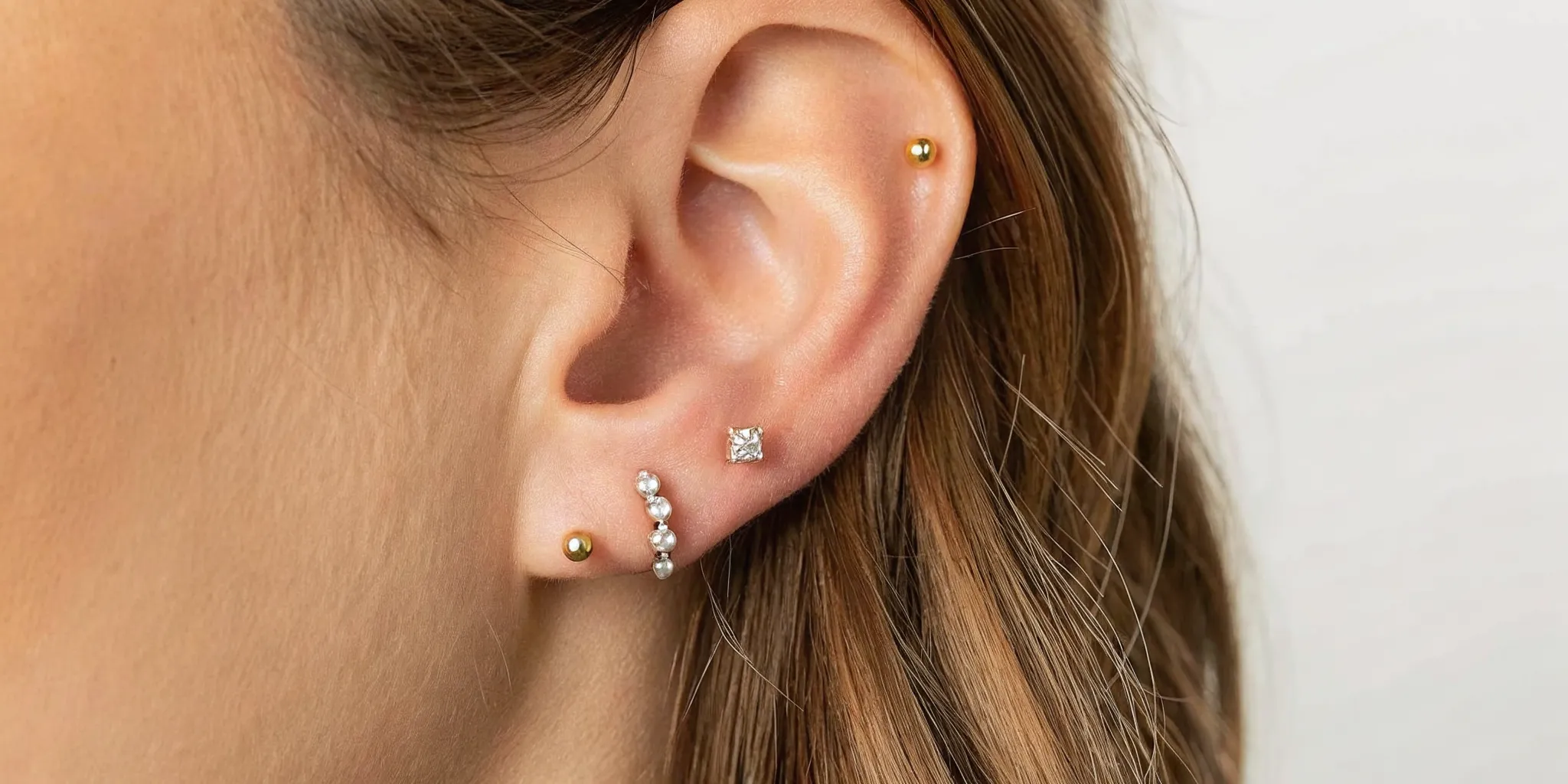
What jewelry works well for different ear piercings?
Well-fitted jewelry in high-quality materials should suit the placement, anatomy, and stage of healing. ASTM F136 implant-grade titanium and nickel-free 14k gold offer refined options for building a durable, coordinated look. The appropriate post length, diameter, and style should be selected for the individual piercing.
Jewelry is more than decoration during healing. Its dimensions and construction affect how it sits and how easy the area is to care for. Decorative ends can express your style, but starter jewelry also needs enough room for expected early swelling. A piercer can explain when downsizing or changing a piece may be appropriate.
Flat-back posts
Flat-back posts create a streamlined look and can support many decorative ends. Depending on the placement and professional recommendation, they are commonly considered for lobes and several cartilage areas. Their low-profile backing can make them visually tidy, but correct sizing still matters.
Hoops and rings
Hoops create movement and can outline a lobe, helix, or healed conch beautifully. However, a hoop is not automatically the best initial jewelry for every placement. Movement, diameter, seam position, and the shape of the ear all matter. Ask what jewelry is suitable now and what can be considered later.
Statement ends, chains, and clusters
Decorative ends, chains, and clusters can transform a simple arrangement into a curated ear. These pieces work best when their size and orientation fit the available space. Chains can visually connect nearby placements without requiring the same alignment as an industrial, while clusters can fill a flat area with one cohesive design.
Why material quality matters
Material quality and verified specifications should be part of the jewelry conversation. Z Edge uses ASTM F136 implant-grade titanium and nickel-free 14k gold. These materials also make it easier to maintain a consistent finish across a stack, whether you prefer a minimal look or a more decorative arrangement.
What should you expect during healing and aftercare?
Healing is gradual, and the timeline varies by placement, anatomy, care, and lifestyle. A piercing can appear calm before the channel has fully matured, so visual appearance alone is not a reliable reason to change jewelry early. Follow the personalized instructions given by your piercer and ask questions when something is unclear.
Lobe tissue generally has different healing considerations than cartilage, and connected placements can require extra attention because two openings share one piece of jewelry. Avoid comparing your progress too closely with another person's timeline. Consistent, gentle care is more useful than chasing a specific date.
Keep the routine simple and consistent
Use the aftercare method your piercer recommends. Avoid twisting or rotating jewelry, and keep unnecessary hands away from the area. Be careful with hair, towels, clothing, headphones, phones, and anything else that may snag or press on the piercing. More products do not necessarily mean better care.
Know when to ask for help
Some early tenderness or localized swelling may occur, but a qualified professional should assess concerns rather than relying on internet photos. Contact your piercer if the jewelry feels too tight, the angle seems to be changing, or irritation persists. Seek appropriate medical care for serious or worsening symptoms. This guide is educational and is not a substitute for individualized professional advice.
Plan jewelry changes with patience
A planned downsize may be recommended after initial swelling settles, while a decorative jewelry change may need to wait longer. Do not assume that every piercing follows the same schedule. Having a piercer evaluate the placement before a change can help protect the look you worked to create.
How should parents plan ear piercing for a child or minor?
Parents should prioritize readiness, informed participation, appropriate identification, and a clear care plan. A child's ability to understand the process and avoid touching the jewelry matters alongside the parent's interest in the service. Requirements can vary, so review them before arriving.
Talk through what the appointment may involve in calm, age-appropriate language. Avoid promising that the experience will feel a certain way. Instead, explain that the piercer will guide the family through each step and that questions are welcome. Planning for aftercare at school, during sports, and at bedtime can make the routine easier to maintain.
The minor piercings information page explains service considerations for families and is a useful starting point before scheduling.
Review minor piercing requirements before planning a visit
How do you prepare for an ear piercing appointment?
Prepare by choosing your priorities, sharing relevant routine details, and arriving ready to discuss placement and jewelry. You do not need a fully finished ear map. A few inspiration images and a clear idea of what you like can help start a productive conversation.
- Save examples that show the placements, spacing, and jewelry scale you prefer.
- List any glasses, headphones, helmets, or work equipment that touch your ears.
- Consider which side you sleep on and whether you can reduce pressure on the new piercing.
- Ask about suitable initial jewelry, aftercare, downsizing, and future styling options.
- Review identification and minor-service requirements when relevant.
It is also helpful to decide whether your priority is one statement placement or a long-term stack. A single appointment can be the beginning of a larger plan. Thoughtful spacing now can preserve options later and prevent the design from becoming crowded.
For practical answers before your visit, review Z Edge Piercing's frequently asked questions.
Frequently asked questions about different ear piercings
What is the easiest ear piercing to start with?
A standard lobe is a common starting point because it offers versatile styling and sits in soft tissue. The best first choice still depends on anatomy, routine, and care expectations, so discuss your goals with a professional piercer.
Can I get multiple ear piercings at once?
Multiple placements may be possible, but the right number depends on the locations, your health and history, and your ability to care for them. A piercer can help decide whether staging the plan would be more manageable.
Do both ears need to match?
No. Matching ears create symmetry, while different arrangements can highlight each ear's anatomy and give you more styling options. Many balanced ear stacks are intentionally asymmetrical.
When can I change my ear piercing jewelry?
The appropriate timing varies by placement and individual healing. A piercing may look settled before it is ready for a change. Ask your piercer to assess it and recommend the right time and jewelry dimensions.
How do I choose between titanium and gold jewelry?
Both ASTM F136 implant-grade titanium and nickel-free 14k gold can support a high-quality look. Choose based on verified material specifications, placement needs, fit, finish, budget, and the style you want to build.
