Rhino Piercing Jewelry: Styles, Fit, and Materials

Rhino piercing jewelry has to follow a vertical channel through the nasal tip, so the useful comparison is curve, gauge, length, and material, not a favorite gem. A curved barbell is the shape that can follow that path. Z-Edge sells ASTM F136 implant-grade titanium curved barbells in stated sizes, plus nickel-free 14K gold threadless ends that attach to a compatible bar. This guide shows how to read those published sizes and choose a piece from the listing instead of guessing from a photograph.
Contact Z-Edge about piercing jewelry
What rhino piercing jewelry has to do
A rhino piercing passes through the tip of the nose, with the channel traveling upward through the tissue. It is not a nostril piercing through the side of the nostril, and it is not a septum piercing in the tissue between the nostrils. The jewelry has to follow that vertical route. A stud or a ring made for another placement will not sit on the same path.
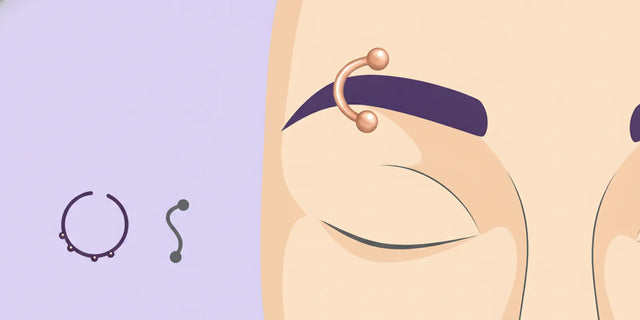
The piece that matches this geometry is a curved barbell: a gently arcing shaft with an end at each side. When the curve and the length are right, the lower end sits toward the tip and the upper end sits higher on the nose. A straight shaft does not make that turn, and a hoop follows a circle instead of the channel.
Style comes after the shaft. A small ball reads quietly. A gem or a shaped end draws the eye. Either look still needs a bar whose gauge and length are printed on the product page. Browse the nostril jewelry collection if you want to see how side-of-nose pieces are built, then come back to a curved bar for a rhino placement.
Which rhino piercing jewelry shape to buy
Start with a complete curved barbell, or with a curve bar plus ends that use the same connection. Z-Edge's internally threaded titanium curved barbells are complete pieces. Both ends unscrew, the balls are solid one-piece counter-sunk ends, and each variant lists gauge, length, and ball size together.
A threadless setup is a different build. The titanium threadless curve bar is the shaft only. It uses a 25g pin, and Z-Edge states that the Invictus threadless tops and bases in that line are interchangeable. You still have to buy the top separately and match it to that pin system. A decorative top is not a barbell.
Leave other shapes off the short list, because a straight barbell, a labret post, a nostril stud, and a septum ring each follow a different path. Z-Edge also sells a 16g internally threaded J-curve barbell, but that page describes the J shape as a way to push the lower end forward for rook and similar placements. Do not treat the J label as a rhino size. Use the standard curved barbell whose length is listed for the channel you have.
How to match gauge, length, and curve
Read three numbers, in this order. Gauge is the thickness of the shaft. A higher gauge number is a thinner bar: 16g is 1.2mm, 14g is 1.6mm. Length is the usable distance of the shaft, not the gem. Curve is the arc of that shaft. For a vertical tip piercing, a bar that is too short presses on the tissue. A bar that is too long sticks out, moves, and catches.
Z-Edge prints those sizes on the product page. Compare them directly:
- 16g (1.2mm) internally threaded curved barbells come in 1/4 inch (6mm), 5/16 inch (8mm), 3/8 inch (10mm), and 7/16 inch (11.2mm), plus 1/2 inch (12.7mm) and 9/16 inch (14mm). The shorter four use 3mm balls. The two longer sizes use 4mm balls.
- 14g (1.6mm) internally threaded curved barbells run from 5/16 inch (8mm) through 9/16 inch (14mm), with 3mm or 4mm balls on the shorter lengths and 4mm balls from 7/16 inch up.
- 16g threadless curve bars come in 5/16 inch (8mm), 3/8 inch (10mm), and 7/16 inch (11.2mm). 14g threadless curve bars come in 3/8 inch (10mm), 7/16 inch (11.2mm), and 1/2 inch (12.7mm). These listings are the bar only.
Use the jewelry you already wear as the measuring stick. If your current piece is a 16g curved barbell at 3/8 inch (10mm), stay on 16g and compare 5/16, 3/8, and 7/16 inch on the same Z-Edge page. Move one length step only when the current bar is visibly long and mobile, or visibly tight with no slack. Do not jump from 16g to 14g to make the bar feel sturdier, because a thicker bar requires a different channel.
Initial jewelry needs a little room for swelling, so the longer end of the worn size is the practical starting point. Once the piercing has settled and the ends sit without pressing or swinging, a downsize is one listed step shorter in the same gauge. If you do not know the current gauge, measure the shaft you have or read it off the old packaging, then select that exact gauge on the curves collection.
Which materials to choose
Z-Edge piercing jewelry is ASTM F136 implant-grade titanium or nickel-free 14K gold. ASTM F136 is the specification for wrought titanium-6aluminum-4vanadium ELI alloy used to make surgical implants. On a Z-Edge titanium page, that shows up as Ti-6Al-4V-ELI ASTM F136, high polish. "Titanium colored," PVD color, or a gold-tone finish is a coating description, not that alloy.
The internally threaded curved barbells and the threadless curve bar are both made from that ASTM F136 titanium. Threading is marked on the page: 16g internally threaded jewelry uses M0.9, and 14g uses M1.2. A top has to match that thread, or, on a threadless bar, the 25g pin. The ASTM F136 implant-grade titanium collection is the right place to confirm the material line before you compare decoration.
Nickel-free 14K gold at Z-Edge is the choice for a decorative end, not a substitute shaft. The 14K gold threadless bar top is solid 14K nickel-free gold with a 316LVM ASTM F138 steel pin, sized 0.45mm by 4.7mm. That steel pin is the small insert that locks into a threadless titanium bar. It is not the jewelry shaft, and it is not a reason to wear a steel barbell. Steel shafts are the inferior option. Z-Edge builds the bar itself in ASTM F136 titanium.
The FDA reviews material information when it evaluates devices that stay in contact with the body, including metals used in implants. Its overview is on the FDA page about metals and materials in medical devices. That page does not size a nose piercing. For the bar itself, use the Z-Edge listing that names Ti-6Al-4V-ELI ASTM F136.
Rhino piercing jewelry options compared
Put construction ahead of the gem. This table uses sizes and materials printed on Z-Edge product pages. It is a buying filter, not a chart that assigns one length to every nose.
| Z-Edge option | What the page lists | How to use it for a rhino piercing |
|---|---|---|
| Internally threaded titanium curved barbell | 16g or 14g. Lengths from 6mm to 14mm. Balls are 3mm or 4mm. Material is ASTM F136. | Best complete piece. Match the gauge you wear, then pick the nearest listed length. |
| Threadless titanium curve bar only | 16g at 8mm, 10mm, or 11.2mm; 14g at 10mm, 11.2mm, or 12.7mm; 25g pin | Buy this shaft, then add an Invictus threadless top. The bar page does not include the decorative end. |
| Threadless curved barbell with a fixed gem bottom | 16g, 5/16 inch (8mm), 3mm prong-set CZ, top not included | A short, simple lower end. Add a compatible threadless top for the other side. |
| Internally threaded spike-end curved barbell | 16g only, 5/16 inch (8mm) or 3/8 inch (10mm), 3mm spike, ASTM F136 | A low-profile look in two short lengths. Skip it if your current bar is longer than 10mm. |
| 14K gold threadless top | Solid nickel-free 14K gold end with a steel pin, not a full barbell | Use it on a titanium threadless curve bar. Do not wear the top alone in the piercing. |
| Straight bar, hoop, or nostril stud | Built for a different path | Do not substitute one because the photo looks similar. |
Compare two curved barbells by gauge, then length, then ball size. A 16g bar at 3/8 inch with 3mm balls is not the same item as a 14g bar at 3/8 inch with 4mm balls, even when the photos look alike. If one page sells only a top, it is not a substitute for the complete barbell.
The curves collection also includes fixed-top pieces with gems, dangles, and chain. Those are still curved barbells, but the ornament changes the profile. A 3mm ball or a 3mm spike stays close to the nose. A cluster, a dangle, or a chain hangs away from it and catches more easily on a towel or a collar. Choose the plain or fixed-gem bar first if you want the jewelry to sit tight to the tip.
How to choose an end without losing the fit
Pick the shaft, then the end. On an internally threaded curved barbell, both balls unscrew, so you can change a threaded end without changing the bar. On a threadless curve bar, the top presses onto the 25g pin. Z-Edge's titanium threadless dome top comes in 2.5mm, 3mm, and 4mm and is made to fit Invictus threadless bars. The 2.5mm or 3mm dome is the lower-profile choice on a nose. The 4mm dome is the louder one.
A gold end follows the same rule. The 14K gold bar top and the 14K gold threadless leaf top are decorative components with a 0.45mm by 4.7mm pin. They fit the threadless titanium curve bar. They do not replace it. Bend the pin slightly, as the product page describes, so the top locks into the bar. Do not bend the titanium shaft to make an end sit differently.
Look at both ends, because a rhino piercing shows from the front and the side. Matching 3mm balls stay even. A gem on the lower end and a plain ball on the upper end puts the decoration where people look. If the end is wider than the ball size listed for that bar, it can overhang the tip and snag. Stay at or under the ball size already paired with your length: 3mm on the shorter 16g bars, 4mm on the longer ones.
What to check before you buy rhino piercing jewelry online
A photo shows the style. The title and the variant menu show what you will receive. Read both before you add anything to the cart.
- Confirm the item is a curved barbell or a curve bar, not a top, a straight bar, or a ring.
- Select the gauge you already wear. Use 16g (1.2mm) or 14g (1.6mm) only if that is the shaft you have now.
- Select the listed length closest to your current bar. Change by one step, such as 10mm to 8mm, not from the shortest option to the longest.
- Check the material line for Ti-6Al-4V-ELI ASTM F136 on the bar. For a gold end, look for solid nickel-free 14K gold, and remember the pin is not the shaft.
- Match the connection. Internally threaded 16g uses M0.9. Internally threaded 14g uses M1.2. Threadless Invictus pieces share the 25g pin.
- Note whether the ends are included. "Bar only" and "without top" mean you still need a compatible end.
Length on these pages is the shaft length, such as 3/8 inch (10mm), with ball or gem size listed separately. Do not add the ball diameter to the shaft and then shop for that larger number. A 10mm bar with 3mm balls is still a 10mm bar.
Category names are a map, not a fit guarantee. The nostril piercing collection and the septum collection show jewelry for other nose placements. Use them to avoid buying the wrong shape. Use the curves collection when you are ready to choose the bar.
How to plan a replacement
Write down four facts from the piece you wear now: curved or another shape, gauge, shaft length, and how the ends attach. If the original card is gone, match the shaft against the millimeter marks on the Z-Edge variant, 8mm, 10mm, 11.2mm, 12.7mm, or 14mm, and keep the gauge the same.
Replace like with like. A style change can be a new end on the same bar. Swap a 3mm ball for a 3mm dome, or add a 14K gold threadless top to a threadless curve bar you already own. A full replacement is a new curved barbell in the same gauge and the nearest listed length. If the current bar presses, choose the next longer listed length in that gauge. If it sticks out and moves, choose the next shorter listed length. Stop there. Trying several unrelated shapes will not tell you which Z-Edge size is next.
Comfort checks are concrete. The ends should sit on the skin without denting it, and the shaft should not swing when you talk or smile. A 3mm ball or dome is less likely to catch on a towel than a spike cluster or a chain dangle. Glasses and mask loops usually clear a vertical tip piercing, but a wide lower end can meet the mask edge. If that happens, drop back to a 3mm end instead of changing gauge.
Keep the product title, the gauge, and the length with the jewelry. Those three details are what you need the next time you reorder. For cleaning supplies after the jewelry is chosen, the H2Ocean aftercare collection lists the products Z-Edge carries. Follow the directions on the product you buy. Do not bend a bar or force an end on because a cleaner or a cloth made the jewelry feel tight.
How to make the choice
Use this order when you order. Confirm you need a curved barbell for a vertical tip piercing. Match the gauge you already wear, either 16g or 14g. Pick the Z-Edge length one step from your current shaft, using the millimeters printed on the variant. Confirm ASTM F136 titanium for the bar. Add a nickel-free 14K gold or titanium end only if it uses the same thread or the same threadless pin. Then decide whether you want a 3mm ball, a dome, a gem, or a leaf.
There is no single rhino length, and you do not need one. The internally threaded titanium curved barbell already lists the practical range, from 6mm to 14mm, with 8mm to 11.2mm covering the sizes most people compare for a settled vertical tip piercing. If the listing does not name the shape, the gauge, the length, and the material, it is not ready to order.
Contact Z-Edge with your jewelry questions
Frequently Asked Questions
What jewelry is worn in a rhino piercing?
A curved barbell. Z-Edge's internally threaded titanium curved barbells come in 16g (1.2mm) and 14g (1.6mm), with shaft lengths from 1/4 inch (6mm) to 9/16 inch (14mm). Match the gauge you wear, then choose the listed length closest to your current bar.
Can I wear a nostril stud or a septum ring?
No. A nostril stud and a septum ring follow different paths. Use a curved barbell from the curves collection, not a piece filed under nostril or septum jewelry.
Which size should I order if I already have jewelry?
Order the same gauge and the same shaft length first. Move one listed step shorter only if the current bar sticks out and moves, or one step longer only if it presses. On the 16g threadless curve bar, those steps are 8mm, 10mm, and 11.2mm.
Which materials does Z-Edge use?
The bar is ASTM F136 implant-grade titanium. Decorative threadless ends are also available in nickel-free 14K gold. The gold top's small pin is 316LVM steel. That pin locks into the titanium bar. It is not a steel shaft, and a steel barbell is not the Z-Edge option.
Is a decorative end a complete barbell?
No. A dome top, a leaf top, or a gold bar top is one component. Pair it with a titanium threadless curve bar in 16g or 14g. An internally threaded curved barbell already includes both balls.